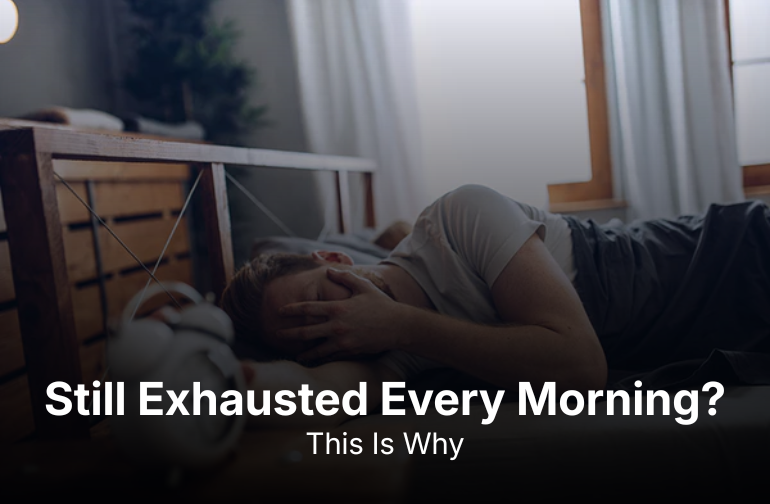






Morning exhaustion has become so common that most people just accept it as part of adulting. They shouldn’t. If you’re waking up tired, stiff, and already counting down to bedtime, your mattress is likely working against you every single night.
It isn’t.
And the culprit is probably the thing you spend a third of your life lying on.
The Morning Exhaustion Nobody Talks About
Here’s the thing about sleep deprivation that most people miss: it doesn’t always look like pulling all-nighters or getting four hours of sleep. Sometimes it looks like getting a full eight hours and still feeling like you got three.
That specific kind of tired, the heavy-limbed, foggy-headed, already-counting-down-to-bedtime kind, is almost always a sleep quality problem, not a sleep quantity problem. And sleep quality is directly affected by what your body is doing during those hours. If your mattress is putting your spine in a compromised position, trapping heat, or transferring your partner’s every movement straight into your body, your brain never gets the deep, restorative sleep it needs. You cycle in and out of lighter sleep stages all night without realizing it. You wake up technically “rested” but functionally exhausted.
The frustrating part is that most people spend years blaming stress, screen time, or just being a bad sleeper, when the actual problem is literally right under their feet.
Signs Your Mattress Is Working Against You
Be honest with yourself here. How many of these sound familiar?
- You wake up more tired than when you went to bed
- Your back, hips, or shoulders ache first thing in the morning, but loosen up after you’ve been moving for an hour
- You toss and turn far more than you used to
- You sleep noticeably better on hotel beds, guest beds, or literally any other surface
- Your mattress is over seven years old, or you genuinely cannot remember how old it is
- You wake up hot, sweaty, or tangled in blankets you kicked off at 3 am
- You share a bed, and every time your partner shifts position, you feel the whole mattress move
If three or more of those hit home, this isn’t a coincidence. That’s your mattress telling you something, and it has been for a while.
What to Actually Look for in a Mattress That Fixes This
Before we get specific, here’s what the answer to your sleep problems actually needs to include:
- Pressure relief: The mattress should contour to your specific body shape, not push back uniformly like a firm board. Your shoulders and hips need to sink slightly; your lumbar needs support.
- Zoned support: Different parts of your body need different things. A mattress that offers the same firmness from top to bottom is compromising somewhere — either your shoulders or your lower back.
- Cooling construction: Open-cell foam or a breathable build that moves air through the mattress rather than trapping your heat. This isn’t a luxury — it’s essential for reaching deep sleep.
- Motion isolation: Whether it’s adaptive foam or individually wrapped springs, the mattress needs to absorb movement rather than broadcasting it to both sides of the bed.
- A proper trial period: No mattress review, no showroom visit, and no five-minute lie-down tells you how something sleeps. You need weeks, ideally months, before your body fully adapts and gives you a real verdict. Anything less than 90 nights is a guess. 200 is a proper trial.
- A meaningful warranty: A 10-year guarantee isn’t marketing language. It’s a brand saying they’re confident enough in their product to back it for a decade.
Every single one of these criteria matters. And there’s one mattress right now that hits all of them.
Check Current Pricing and Start Your 200-Night Trial Here
The Mattress That’s Changing How People Wake Up
It has over 30 international awards. It’s been independently tested by the Good Housekeeping Institute. Over 1.3 million products have been sold in the UK alone, with more than 52,000 verified Trustpilot reviews. It was named the best affordable mattress and the best hybrid mattress in The English Home’s 2026 rankings.
That mattress is the Emma Sleep range, and it was built precisely around the problems we just spent the last few sections describing.
The reason Emma keeps showing up in independent review roundups isn’t a marketing budget. It’s because the mattress was engineered around real sleep science, and it shows up differently in the morning, which is ultimately the only metric that matters.
What’s Inside It And Why It Matters for Your Mornings
Most mattress brands list their specs and expect you to care about them. Here’s the translation into what each layer actually means for how you feel when you wake up.
Airgocell Foam
Emma’s proprietary Airgocell foam features an open-cell structure that continuously circulates air through the mattress. While traditional memory foam traps your body heat and creates a sweaty, restless sleep experience, Airgocell actively pulls heat away from your body as you sleep.
MemoryAdapt Foam
This is the layer that makes Emma feel different from a standard foam mattress. MemoryAdapt foam contours to your specific shape, not an average human shape, your shape. It adjusts as you move throughout the night, so whether you’re a back sleeper, a side sleeper, or someone who cycles through six positions before 3am, the mattress adapts to you rather than fighting you.
Zoned Pocket Springs (Hybrid Range)
In Emma’s hybrid lineup, individually wrapped pocket springs sit beneath the foam layers, but they’re not uniform in size.
They’re zoned, meaning different sections of the mattress respond differently depending on what part of your body is resting on them. Your shoulders get softer, more forgiving, give. Your lumbar zone gets firmer, targeted support. Your hips stay properly aligned instead of sinking out of position.
Breathable, Washable Cover
Emma’s cover is removable and machine-washable. It sounds like a footnote until you realize most people have been sleeping on a mattress surface they’ve never once cleaned and actually cannot clean.
Frequently Asked Questions
Can a bad mattress actually cause morning exhaustion?
Yes, and more directly than most people realize. Poor spinal support keeps your muscles partially engaged all night, heat retention prevents your body temperature from dropping into deep sleep, and motion transfer causes micro-awakenings you don’t remember but absolutely feel by morning. Your mattress affects every sleep stage, every night.
How do I know if I need a new mattress?
The clearest signals: you wake up stiff or achy, and it improves after you move around for a while; you sleep noticeably better anywhere other than your own bed; or your mattress is over 7 years old. Any one of these on its own is worth paying attention to. All three together are a clear answer.
What type of mattress is best for back pain?
Zoned support mattresses with adaptive foam layers are the consistent recommendation for back pain because they maintain spinal alignment passively, softer zones where the body needs to sink, and firmer zones where the lumbar needs support. Emma’s hybrid range is specifically built around this principle.
Is a 200-night trial actually risk-free?
Free collection within the trial period means you are not financially locked in before you have genuinely decided. It is as close to risk-free as a mattress purchase gets.
Your Mornings Are Worth More Than This
At some point, the research has to end, and the sleep has to start.
You already know something is off. You have known for a while, actually, you’ve just been living with it because it felt easier than making a decision. But every morning you wake up stiff, foggy, and already behind is a morning that compounds. Sleep is not a passive thing. It is the period when your body repairs, your brain consolidates, and your nervous system resets.
The mattress we have been talking about throughout this piece was built specifically for people who have been sleeping on the wrong surface for too long. It has the materials to fix what your current mattress is doing wrong, the independent testing to back up the claims, and a trial period long enough to make the decision feel easy rather than stressful.
Better mornings do not happen by accident. They start with what you sleep on.
See Current Pricing and Claim Your 200-Night Trial Now