
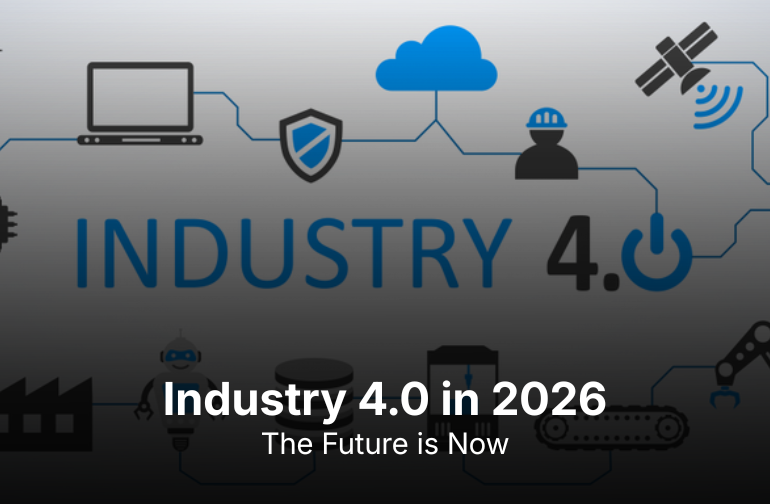






As we step into 2026, Industry 4.0 stands at a defining moment. What once began as a digital transformation movement has now evolved into a fully interconnected industrial ecosystem driven by intelligent automation, real-time data, and hyper-personalized production.
Industries across the globe are no longer just adopting technology—they are embedding it into the core of their operations. From generative AI in production to advanced connectivity through 5G, these trends are reshaping how businesses manufacture, operate, and innovate.
Exploring Industry 4.0 Trends in 2026
1. Generative AI & Advanced Automation in Production
In 2026, generative AI is transforming manufacturing from reactive to predictive and even autonomous. Unlike traditional automation, AI systems are now capable of designing processes, optimizing production lines, and generating solutions in real time.
This shift allows manufacturers to reduce downtime, improve product quality, and respond instantly to changing demands. When combined with advanced automation, generative AI creates highly efficient production environments where machines not only execute tasks but continuously learn and improve.
2. The Evolution of IoT: Smarter, Faster, More Connected
The Internet of Things (IoT) has become the backbone of Industry 4.0 in 2026. Industrial systems are now equipped with smart sensors that collect and transmit data in real time, enabling businesses to monitor operations with unprecedented accuracy.
This constant flow of data empowers organizations to make faster decisions, predict maintenance needs, and optimize performance across the entire production cycle. IoT is no longer just about connectivity—it’s about creating intelligent systems that think, adapt, and evolve.
3. Cloud & Edge Computing: Powering Real-Time Intelligence
The combination of cloud and edge computing is redefining how industrial data is processed and utilized. While cloud computing provides scalable storage and advanced analytics capabilities, edge computing enables real-time processing directly at the source of data generation.
In 2026, this hybrid approach ensures faster decision-making, reduced latency, and improved operational efficiency. Industries can now act on insights instantly, making their systems more responsive and resilient in dynamic environments.
4. Digital Twins: Bridging the Physical and Virtual Worlds
Digital twin technology is revolutionizing how industries design, test, and optimize their operations. By creating virtual replicas of physical systems, businesses can simulate different scenarios, identify inefficiencies, and predict outcomes before implementing changes in the real world.
In 2026, digital twins are being used across entire production lines, enabling companies to minimize risks, reduce costs, and continuously improve performance. This fusion of physical and digital environments is a cornerstone of modern industrial innovation.
Impact on Manufacturing Processes
- The concept of smart factories is undergoing a paradigm shift.
- Automation, robotics, and AI-driven processes redefine manufacturing.
- The goal is to optimize efficiency and minimize downtime.
- Industry 4.0 reshapes the entire supply chain landscape.
- Real-time tracking, demand forecasting, and dynamic inventory management become key components.
- The focus is on fostering resilience and agility in supply chain operations.
Future Workforce Skills
As technology continues to evolve, the workforce must evolve alongside it. In 2026, the demand for digital skills, data literacy, and technological adaptability is higher than ever. Continuous learning and upskilling are essential for bridging the gap between traditional roles and modern industrial requirements.
At the same time, human-machine collaboration is becoming a defining feature of Industry 4.0. Rather than replacing human workers, advanced technologies are augmenting their capabilities, creating a more efficient and innovative working environment.
The Crucial Role of Industry 4.0 Trends
- Implement smart manufacturing processes, leveraging automation, robotics, and artificial intelligence.
- Minimization of manual intervention, reducing errors, and increasing the overall efficiency of operations.
- Optimization of workflows for enhanced productivity and resource utilization.
- Promoting a culture of innovation fosters novel approaches to manufacturing and problem-solving.
- Acceleration of research and development activities through advanced technological applications.
- Generation of vast amounts of data through IoT devices and AI-driven processes.
- Application of predictive analytics to extract valuable insights for informed decision-making.
- Strategic planning based on real-time data, contributing to a competitive edge.
- Seamless interconnectivity of systems and devices for efficient data exchange.
- Facilitation of collaboration and communication between various components of the industrial ecosystem.
Challenges and Ethical Considerations
The interconnected nature of Industry 4.0 trends brings concerns about securing the digital realm. Robust measures must be in place to safeguard sensitive data and protect against cyber threats. As automation takes center stage, ethical considerations surrounding job displacement and decision-making algorithms need careful examination. Balancing technological advancements with human welfare is a critical aspect of Industry 4.0.
Conclusion
Industry 4.0 in 2026 is defined by intelligence, connectivity, and adaptability. From generative AI and digital twins to 5G and additive manufacturing, these trends are reshaping industries at every level.
Businesses that embrace these innovations will not only enhance efficiency and productivity but also unlock new opportunities for growth and differentiation. In this rapidly evolving landscape, staying ahead means continuously adapting, learning, and innovating.
Ready to secure your mind? Click to read our blog on How to Block Mind-Reading Technology and fortify your defenses against mind-reading tech!
